How FileFlo works · Demonstration data
See howFileFlo works.
A step-by-step walkthrough in text. For carriers, follow one driver's file from the first upload to the audit packet, shown with demonstration data on a test carrier. For Part 135 operators, request a walkthrough with your quote.
Walk through it with FileFlo.
Request an aviation quote and ask for a walkthrough. A person at FileFlo answers in writing. The walkthrough follows one trip:
- Each crew member and the aircraft checked against the records on file and returned cleared or blocked.
- Each block with the missing record, its holder, its expiry and the rule.
- The checks behind each status: computed from the records, a grace-month check never shown as cleared, a self-signed or out-of-fleet check refused with the reason.
- The aircraft's annual, its registry details and the operation's documents with their status.
- The audit packet, with an inspector link limited to one aircraft or one crew.
- The release decision, which stays with your Director of Operations.
Pricing is by written quote. FileFlo reports readiness, and your Director of Operations makes the operational decision.
01 · The file
One driver, one file.
02 · Records in
Sent from the driver's phone.
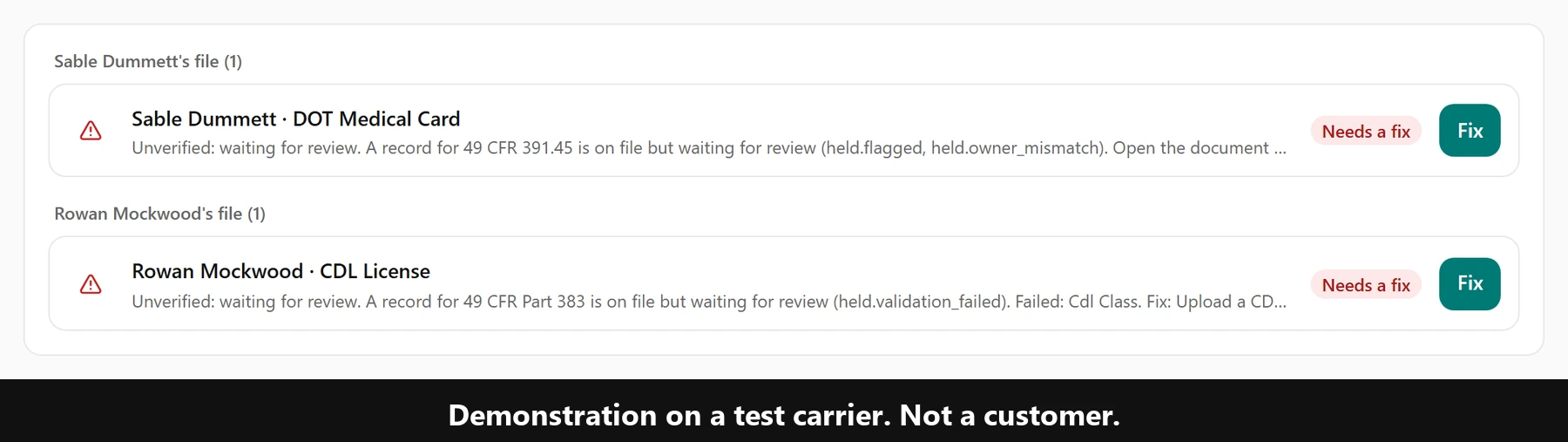
03 · Held, with the fix
A medical card, held for review.
04 · The packet
The file as an inspector sees it.
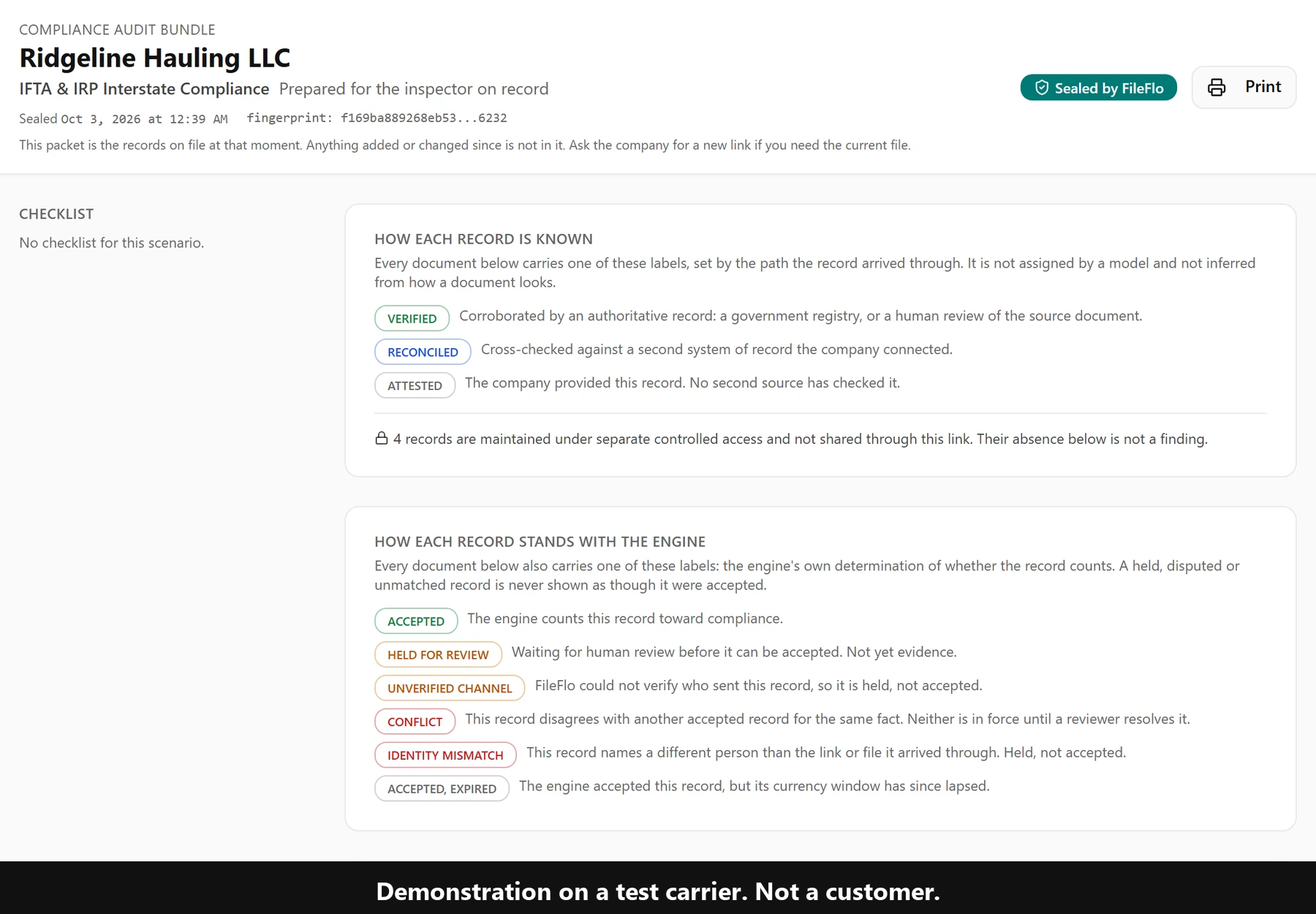
- The audit packet: every requirement with its citation, each person's missing records named, and each document's standing beside where it came from.
- A sealed inspector link: a frozen snapshot with its fingerprint, an expiry, an access cap, revocation and a log of every access.
- The inspector view, without the carrier's gap notes and risk math, with drug and alcohol records shown as a count.
- A public page where anyone holding the packet can check its fingerprint and confirm it is the one the carrier issued.
Where your team comes in.
- Nothing goes out to drivers until the carrier switches each routine on and chooses who hears, how and when.
- The carrier's providers order the MVR, run the Clearinghouse query and administer the drug and alcohol program; FileFlo files each result.
- Records can also be emailed to the carrier's own inbox address for the office to review before filing.
The same build, from your USDOT number.
The Audit-Ready Setup, $499 once: your gap report, your driver files and your packet with its inspector link, and 30 days of Core. Your 14 calendar days start once we have your USDOT number, the name of at least one driver and one usable record, and they never pause. If your files are not organized and audit-retrievable by the end of them, the $499 comes back.
The button opens a short request form, and a person at FileFlo answers in writing with the terms.
What the Setup buys, what it needs and what happens after you pay